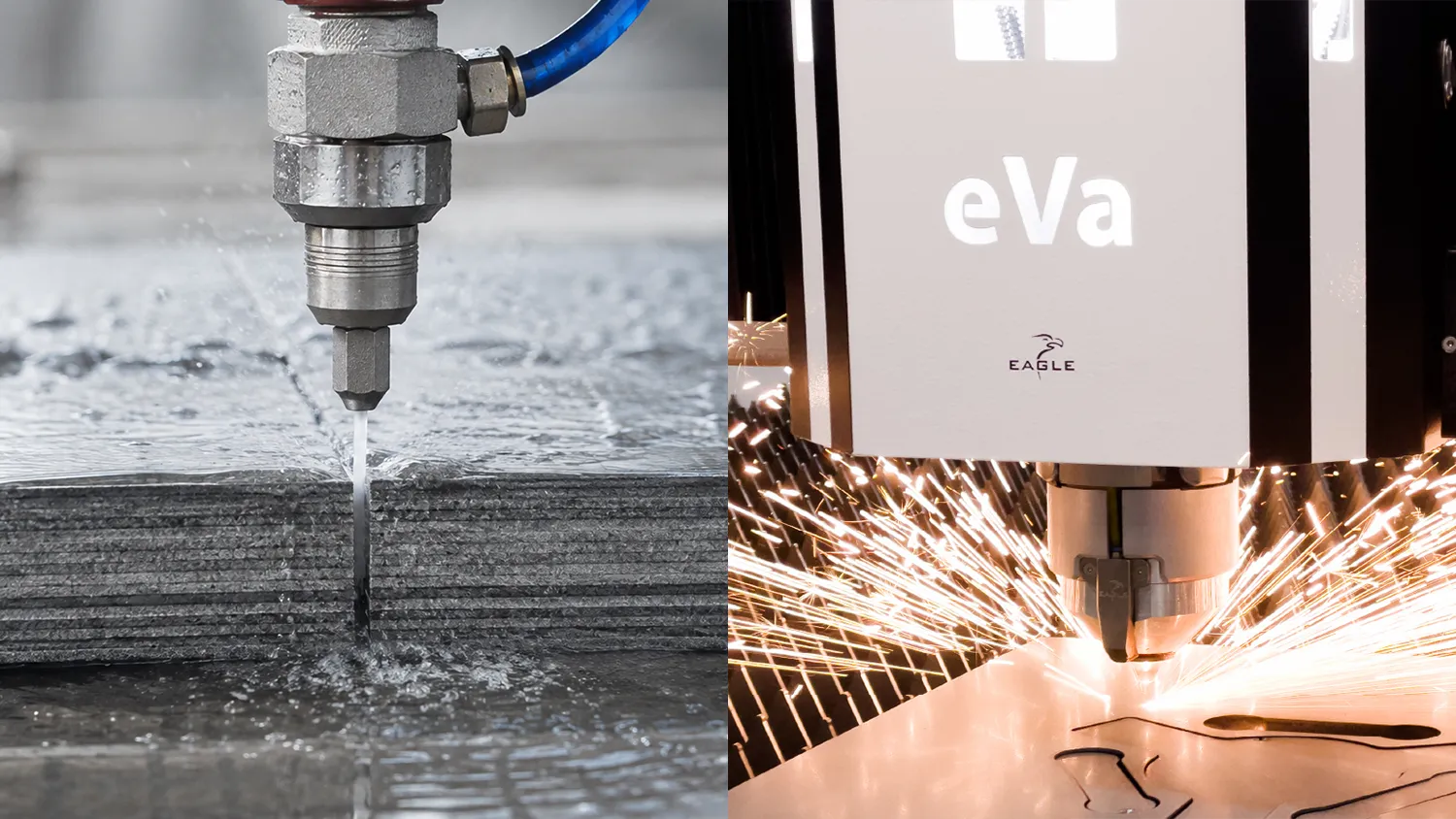
Choosing between fiber laser and waterjet cutting is not only a question of what each technology can cut. It is a question of production priorities.
Fiber laser cutting is built for speed, precision, repeatability, and automation in metal processing. Waterjet cutting is built for material versatility and for applications where thermal impact must be avoided.
Both technologies have a valid place in manufacturing. The right choice depends on the material, required edge quality, thickness range, production volume, and whether the priority is maximum flexibility or maximum output.
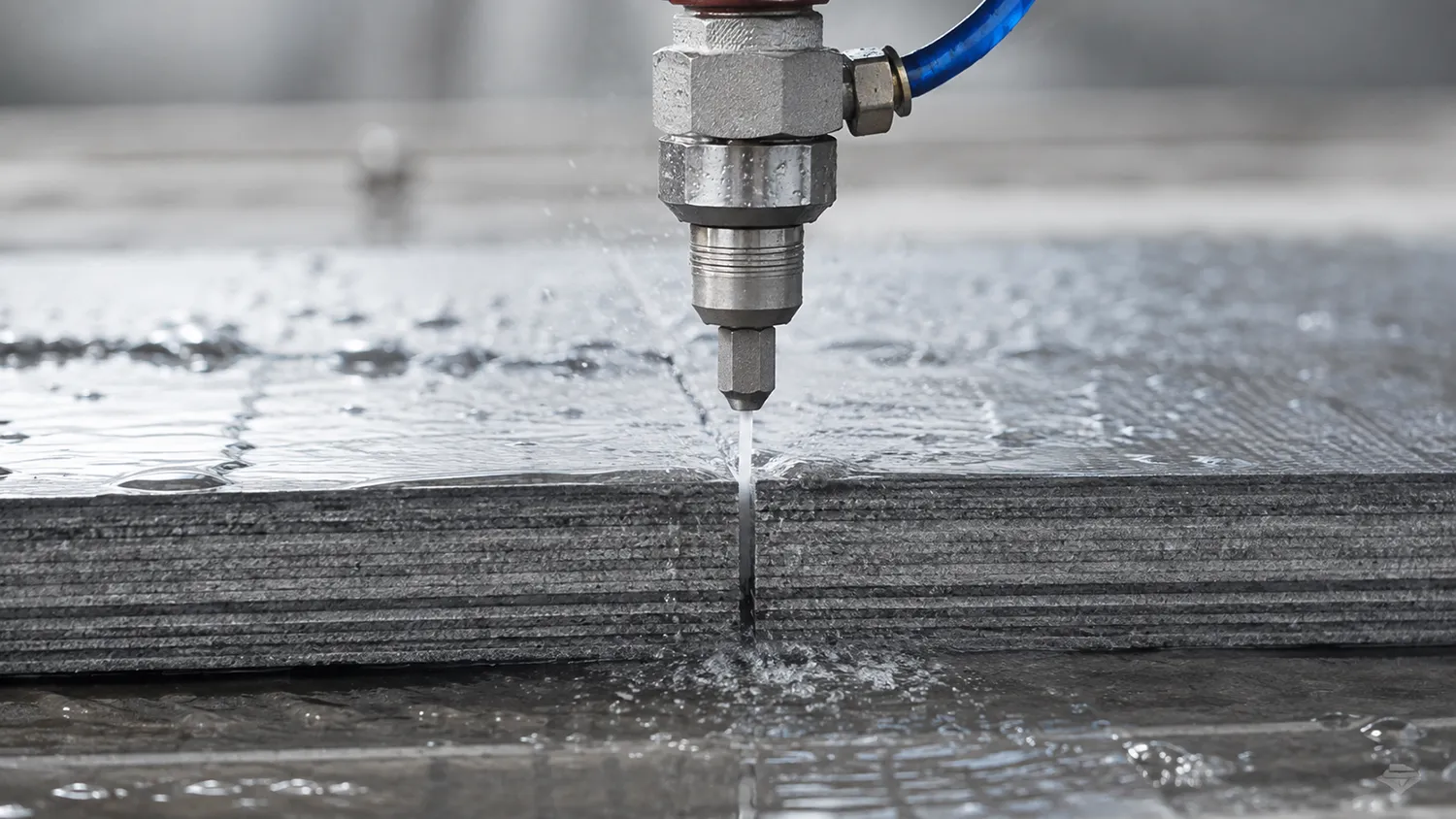
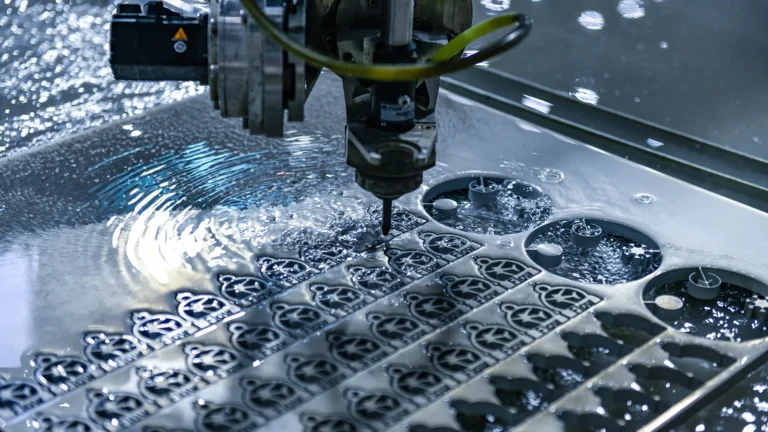
Waterjet cutting uses a highly pressurized stream of water to erode material along a programmed cutting path. When cutting metals, stone, glass, or other hard materials, abrasive particles are often added to increase cutting power.
Unlike laser cutting, waterjet cutting does not melt the material. It removes it mechanically. This means there is no heat-affected zone, no thermal distortion, and no hardening caused by the cutting process.
That makes waterjet valuable for materials that are sensitive to heat or for applications where the internal structure of the material must remain unchanged. It is also one of the most versatile cutting methods, because it can process many materials beyond metals.
The trade-off is productivity. Mechanical erosion is inherently slower than the high-speed thermal process used in fiber laser cutting.
The simplest way to understand the difference is this:
Fiber laser is optimized for industrial metal production.
Waterjet is optimized for broad material capability and thermal safety.
Fiber lasers use a focused beam to melt or vaporize metal with high precision. Combined with fast motion systems and automation, this makes them especially effective in sheet metal production, where speed, repeatability, and cost per part matter.
Waterjet cutting, by contrast, uses mechanical force. It can cut metals, composites, stone, glass, plastics, rubber, and other materials that are not suitable for fiber laser cutting. However, because the process removes material by erosion, it is usually much slower in production environments.
This does not make one technology universally better. It means they solve different problems.
Fiber laser cutting delivers very high precision, narrow kerf, and strong repeatability. It is particularly effective for intricate geometries, small details, and production runs where parts must remain consistent over time.
Because the process is fast and controlled, fiber laser cutting often produces parts that require little or no secondary finishing, especially when the machine, gas strategy, and cutting parameters are correctly matched to the material.
Waterjet cutting can also produce accurate parts, but the edge character is different. The process may create a wider cut and can be affected by jet behavior, abrasive flow, and material thickness. Its main advantage is not maximum speed or fine detail, but the absence of thermal influence.
So the decision depends on what matters more: fine, repeatable metal cutting at production speed, or cutting without introducing heat into the material.
For a broader view of metal behavior under the laser beam, see What Materials Can Fiber Lasers Cut?
This is where fiber laser cutting has a clear production advantage.
Fiber lasers are designed for high-speed metal cutting. They perform especially well in thin and medium sheet metal, where fast acceleration, precise beam control, and automated handling can significantly increase output.
Waterjet cutting is slower by nature. Since the material is removed through erosion, the process takes more time, and thicker or harder materials increase that difference further.
For one-off parts, prototypes, or heat-sensitive materials, this slower process may be acceptable. In high-volume metal production, it can become a serious limitation.
This is why manufacturers focused on throughput, short lead times, and scalable production usually favor fiber laser cutting. The question is not only how cleanly a machine can cut. It is how many good parts it can produce per shift.
Waterjet has the broader material range. It can cut metals and many non-metal materials, including glass, stone, ceramics, composites, rubber, and plastics. It is also useful for very thick materials or parts where thermal change is unacceptable.
Fiber laser is more specialized. Its strength is metal processing: mild steel, stainless steel, aluminum, galvanized steel, copper, brass, and other industrial metals, depending on machine configuration and application.
That specialization is also its advantage. Fiber laser cutting is not trying to be universal. It is designed to cut metal quickly, accurately, and repeatedly in a production environment.
Waterjet is the better choice when the material defines the process. Fiber laser is the better choice when production performance defines the process.
Operating cost should not be evaluated only by hourly machine cost. The more important metric is cost per finished part.
Fiber laser cutting usually has a strong advantage in series metal production because it combines high speed, low consumable dependency, automation potential, and repeatable process control. The more parts produced per hour, the more the machine can reduce cost per part.
Waterjet cutting has a different cost structure. Abrasive consumption, pump maintenance, nozzle wear, water handling, and slower cycle times all influence the final economics. In some applications, these costs are justified because waterjet can cut materials or thicknesses that laser cutting cannot process efficiently.
But when the application is standard sheet metal production, waterjet often struggles to match the productivity and scalability of fiber laser systems.
For more context on how production costs should be evaluated, see Laser Cutting Operating Costs: Gas, Energy and Maintenance Explained.
Fiber laser cutting fits naturally into automated production. Modern systems can be connected with loading and unloading automation, storage towers, software, reporting tools, and full material-flow solutions.
This matters because the laser itself is only one part of the production system. If the machine cuts quickly but waits for material, sorting, or operator intervention, the full process is still inefficient.
Waterjet systems can also be automated, but the process is generally less suited to the same high-speed production flow as fiber laser cutting. The slower cutting mechanism and abrasive-based process make it a different kind of manufacturing tool.
For companies trying to increase output, reduce manual handling, and build scalable sheet metal production, fiber laser usually offers a stronger foundation.
| Factor | Fiber laser cutting | Waterjet cutting |
| Cutting principle | Thermal cutting with a focused laser beam | Mechanical erosion using high-pressure water and abrasive |
| Best fit | Industrial metal production | Mixed materials, thick materials, heat-sensitive applications |
| Speed | Very high in sheet metal production | Slower, especially as material thickness increases |
| Precision | Excellent for repeatable metal parts and fine geometries | Good, but process behavior depends strongly on material and setup |
| Thermal impact | Small heat-affected zone | No heat-affected zone |
| Material range | Mainly metals | Metals and many non-metals |
| Consumables | Relatively low consumable dependency | Abrasive and wear components are central to the process |
| Automation potential | Very strong in sheet metal production | Possible, but less suited to high-speed metal production flow |
| Cost logic | Strong cost per part in series metal cutting | Justified when material flexibility or no thermal impact is required |
Choose fiber laser cutting when your main priority is productive metal processing. It is the stronger option for manufacturers working with sheet metal, repeatable part production, tight lead times, automation, and cost-per-part reduction.
In practical terms, fiber laser answers a production question: how fast and efficiently can we produce metal parts?
Choose waterjet cutting when the material or application requires a non-thermal process. It is the better fit for mixed-material environments, very thick sections, heat-sensitive materials, or applications where thermal influence cannot be accepted.
Waterjet answers a material question: how can we cut this material without heat?
Waterjet cutting offers exceptional flexibility. It can process a wide range of materials and avoids thermal impact entirely. For certain applications, that makes it the correct choice.
Fiber laser cutting is more specialized, but that specialization is exactly why it dominates modern sheet metal production. It delivers speed, precision, repeatability, automation potential, and strong cost-per-part performance.
For manufacturers focused on scalable metal production, the decision is rarely about whether waterjet can cut the material. It is about whether the process can meet the required output, efficiency, and production economics.
In most sheet metal environments, fiber laser cutting is the stronger production tool. Waterjet remains valuable when material versatility or zero thermal impact matters more than speed.