
There is a difference between making a good cut and running a good cutting process. Not a particularly subtle one, either, although you wouldn’t necessarily know it from the way laser machines are usually demonstrated.
A new machine cuts a complicated part, the operator picks it up, someone examines the edge, and everyone is satisfied. Fair enough. But that part tells us relatively little about what happens after several hours of production, when the cutting head has been working continuously, the material changes from one batch to another, and the operator has rather more to worry about than admiring a clean edge.
That’s where process stability comes in. And it deserves at least as much attention as cutting speed.
Laser cutting is a balancing act between several variables. Power, speed, focal position, gas pressure, material properties. Change one and the others may need adjusting.
None of this is news to anyone who has programmed a cutting machine. The difficulty is that these variables don’t operate independently, and the best setting for one quality characteristic isn’t necessarily the best for another.
A 2026 study published in Engineering Science and Technology, an International Journal examined fiber laser cutting of AISI 430 stainless steel, looking at the effects of cutting speed, gas pressure and focal position on surface roughness, dross formation, hole accuracy and energy consumption.
Different parameters influenced different quality measures. Improving one result didn’t automatically improve the others.
Yet production decisions are often made around one particularly attractive number, usually cutting speed.
Every cutting process has a process window: the range of conditions within which it produces acceptable results. Finding that window is one job. Keeping the process inside it over a full production run is another, especially when nozzle condition, material variation and thermal effects enter the equation.
The cutting nozzle is hardly the most impressive-looking component on a modern fiber laser. Compared with a 40 or 60 kW source, a little piece of machined copper doesn’t offer much excitement. But its condition matters enormously.
The assist gas has to remove molten material from a narrow kerf, sometimes through several centimetres of steel. Its effectiveness depends on pressure, nozzle geometry, alignment and distance from the sheet.
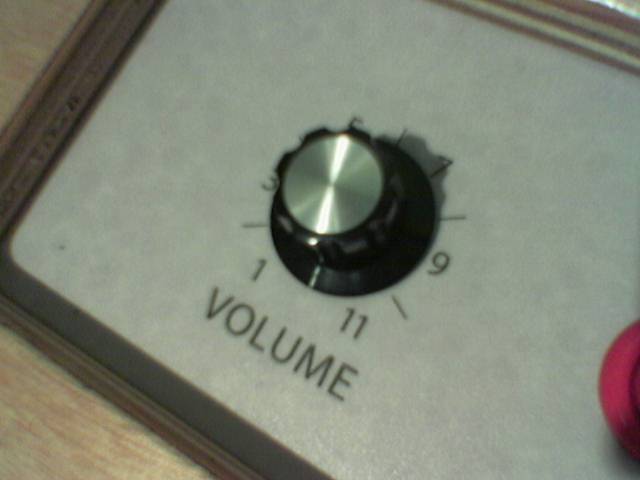
More pressure isn’t necessarily the answer. As anyone who’s seen This Is Spinal Tap knows, turning the dial up to eleven doesn’t necessarily improve the performance.
Researchers writing in Results in Engineering in 2025 investigated air-assisted fiber laser cutting of AISI 304 stainless steel using an optimized supersonic nozzle. Compared with the conventional design tested, their nozzle reduced kerf width by approximately 20% and maximum dross height by around 55%.
Those figures belong to a specific experimental arrangement, but the difference produced by changing the gas flow is worth noting. The laser itself wasn’t the whole story.
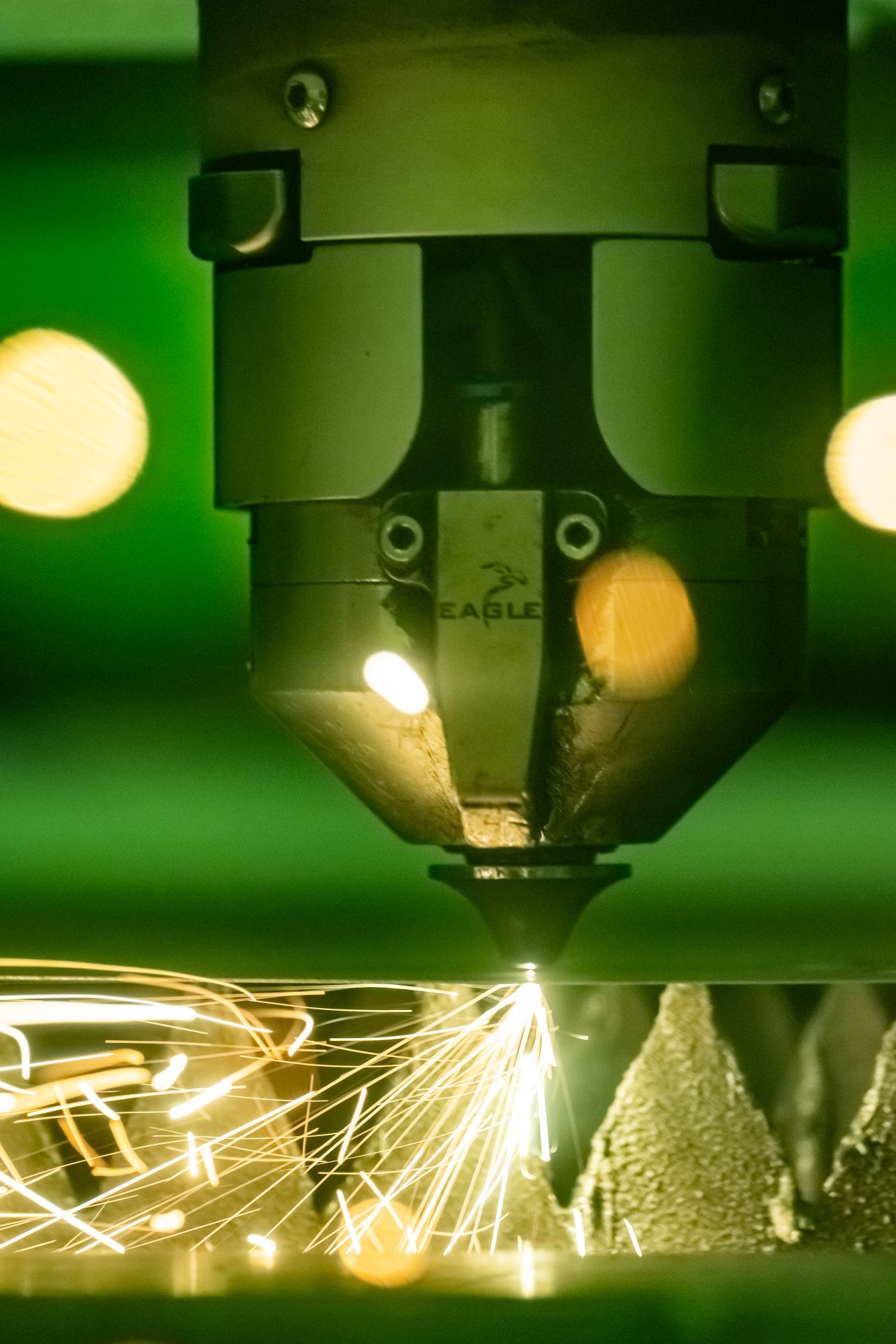
In everyday production, an incorrectly centered nozzle can disturb gas distribution around the beam, affecting cut quality. Eagle’s ANC CAM combines automatic nozzle changing with camera-assisted beam centering, reducing the manual work involved in establishing the correct conditions.
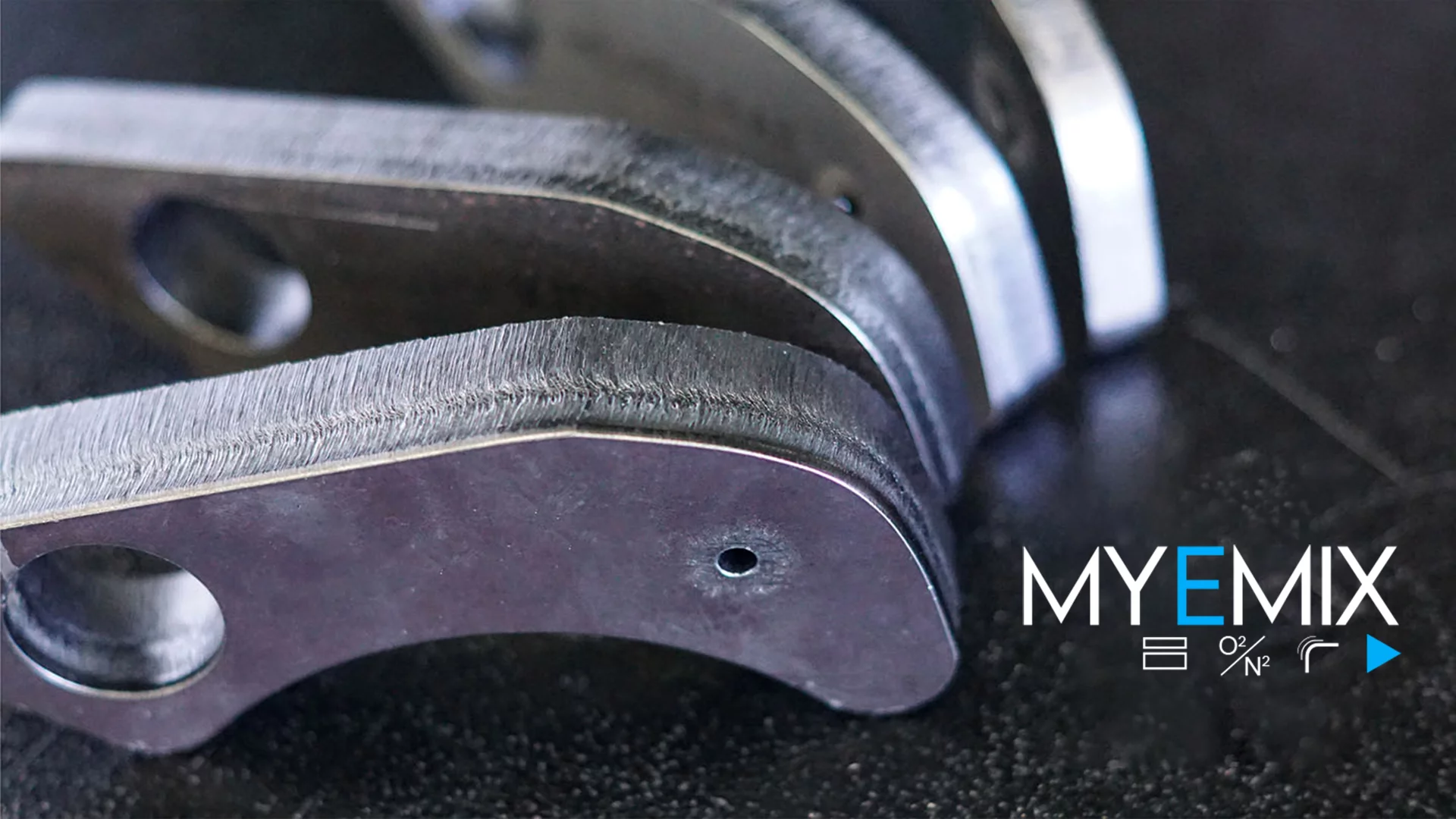
Gas composition adds another variable. Systems such as MyEMIX use controlled nitrogen-oxygen mixtures for specific applications, where the interaction between gas and material affects the cutting process.
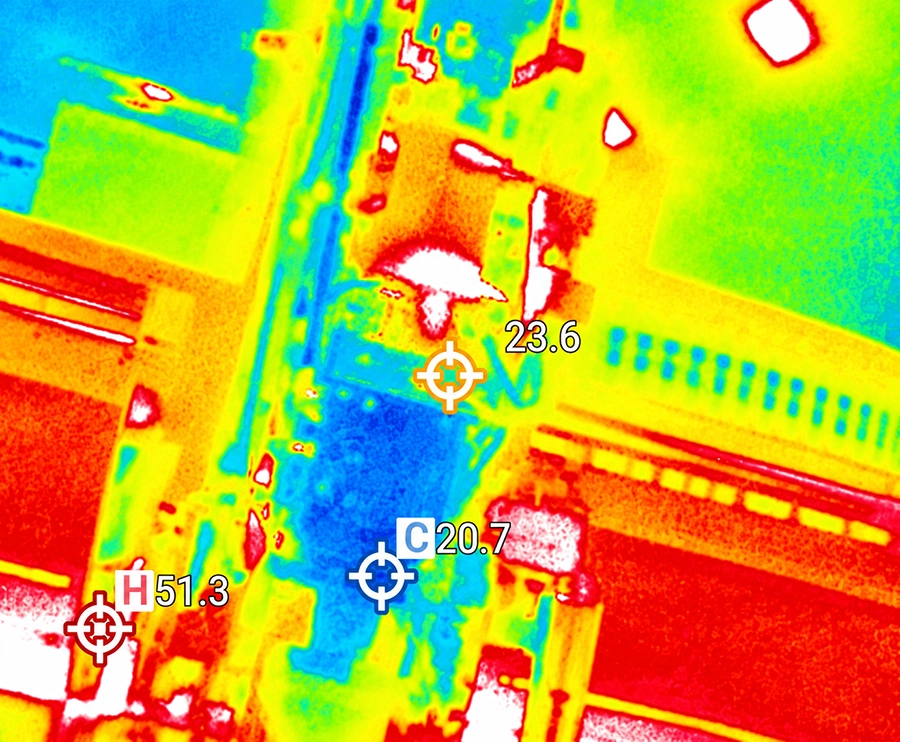
High laser power doesn’t automatically make cutting unstable. But transmitting tens of kilowatts through an optical system makes thermal management a serious engineering concern.
Optical components transmit the beam with minimal losses. Minimal isn’t zero, however. Even small amounts of absorbed energy generate heat, potentially affecting optical characteristics, including focal position.
A parameter table can specify the correct focus. It cannot guarantee that the optical system will maintain precisely the same conditions throughout operation.
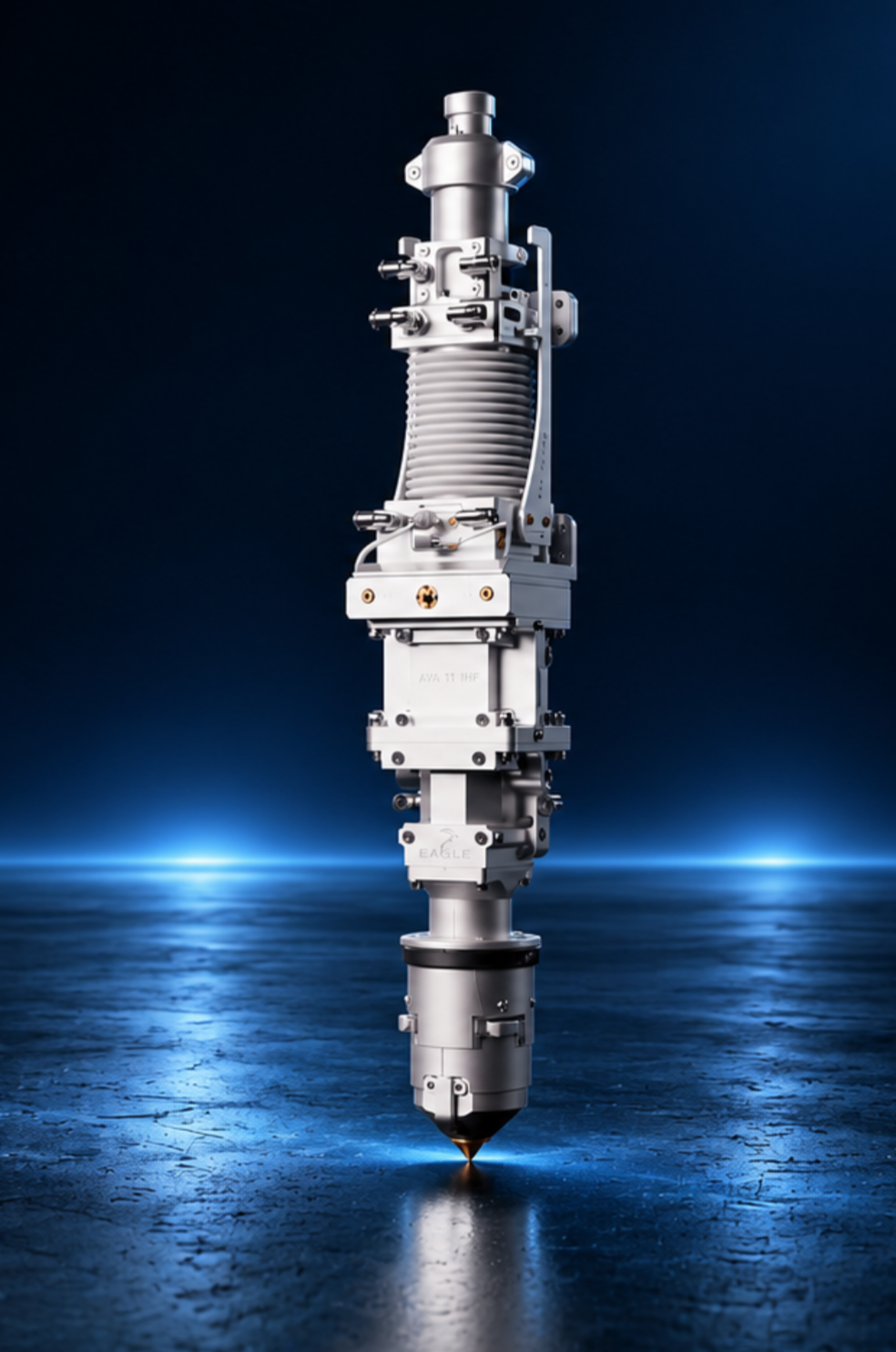
Eagle’s eVa 11-UHP, designed for operation between 20 and 60 kW, uses a redesigned optical arrangement and cooling along the beam path. The distance sensor has its own cooling system, addressing another potential source of thermal variation.
Thick-plate cutting adds further complications. Molten material must be removed through a deeper kerf, and oxygen-assisted cutting of mild steel introduces additional heat through the oxidation reaction. It is a different process from nitrogen fusion cutting, requiring different parameters and gas conditions.
Eagle’s MyECATFAST addresses thick mild-steel oxygen cutting through application-specific strategies, including measures intended to reduce nozzle temperature.
None of these measures makes parameter selection irrelevant. They help address conditions that become more demanding as power and material thickness increase.
Inspecting the finished part remains one of the most straightforward ways to assess cut quality. Look at the edge, check for dross, measure it if necessary.
Effective, certainly. But by then the cutting operation has already happened.
Researchers are investigating ways to assess quality during the process itself. In a 2026 study published in Procedia CIRP, scientists at Fraunhofer IWS analyzed coaxial video recordings of fiber laser cutting on 10 mm AISI 304 stainless steel.
By examining characteristics of the recorded images, they developed a model to estimate dross formation. The correlation coefficient between estimated and measured values was 85.1%.
An interesting result, although correlation isn’t the same as a system that detects every defect, much less one that automatically corrects the cutting parameters.
Monitoring can reveal what is happening. Closed-loop control goes further by using that information to adjust the process. The distinction matters, particularly when evaluating claims about intelligent manufacturing.
Machine demonstrations focus on impressive cutting results for understandable reasons. They’re easy to see, easy to compare and, when the numbers are good, easy to communicate.
Consistency is harder to demonstrate.
A clean edge on a 50 mm plate tells us something about a machine’s capability. So does a particularly fast cutting cycle. Neither tells us how reliably that result can be repeated, how often an operator needs to intervene, or how many parts will meet the required tolerance over a longer production run.
Those figures rarely make it into the demonstration.