
A laser cutting machine can process a sheet of steel in a fraction of the time it took a few years ago. Getting the finished parts off the table is a different matter.
Cutting technology has advanced considerably, with higher laser power, faster positioning and improvements in cutting processes. But these gains put more pressure on the operations surrounding the machine. Once cutting times fall, unloading and sorting can become a significant part of the production cycle.
Many workshops still handle this work manually, and for good reason. Manual sorting is flexible, requires no additional investment in automation and can be perfectly adequate for certain types of production. The situation changes when a machine finishes cutting faster than an operator can clear the table and prepare it for the next sheet.
A University of Padua case study. The project investigated integrating laser cutting with automatic part separation and stacking, replacing work previously performed manually.
The underlying challenge is familiar to anyone running a busy sheet metal shop. Faster cutting only improves overall throughput if the rest of the production process can keep pace.
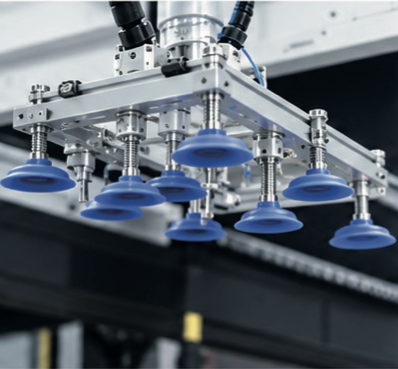
Sorting cut components is more complicated than simply picking them up and moving them somewhere else. A sheet may contain dozens of parts with different shapes, dimensions and weights. Some are easy to grip, while others offer little surface area for a vacuum cup. Thin components can be difficult to handle without disturbing adjacent parts.
The material matters, too. Magnetic grippers are suitable for many steel components but cannot be used in the same way with aluminium. Vacuum tools provide another option, although their effectiveness depends on the part’s geometry and surface.
There is also the question of removal sequence. Components need to be collected without obstructing access to the remaining parts, and the handling system must move between pickup and placement positions efficiently. An unsuitable sequence can add unnecessary movements to a cycle that may already be constrained by the cutting machine’s output.
These difficulties have attracted research attention beyond conventional sheet metal production. A 2025 study on sorting irregular metal parts in shipbuilding examined the optimization of collection routes and sorting sequences. Research into machine-vision-based sorting has also explored how automated systems can identify metallic workpieces with complex geometries.
The applications differ, but the technical requirements overlap. A handling system must identify the component, select an appropriate gripping method and determine how to remove and place it without interfering with the other parts.
One way to address these challenges is to give the handling system greater freedom of movement and the ability to work with different types of gripping tools.
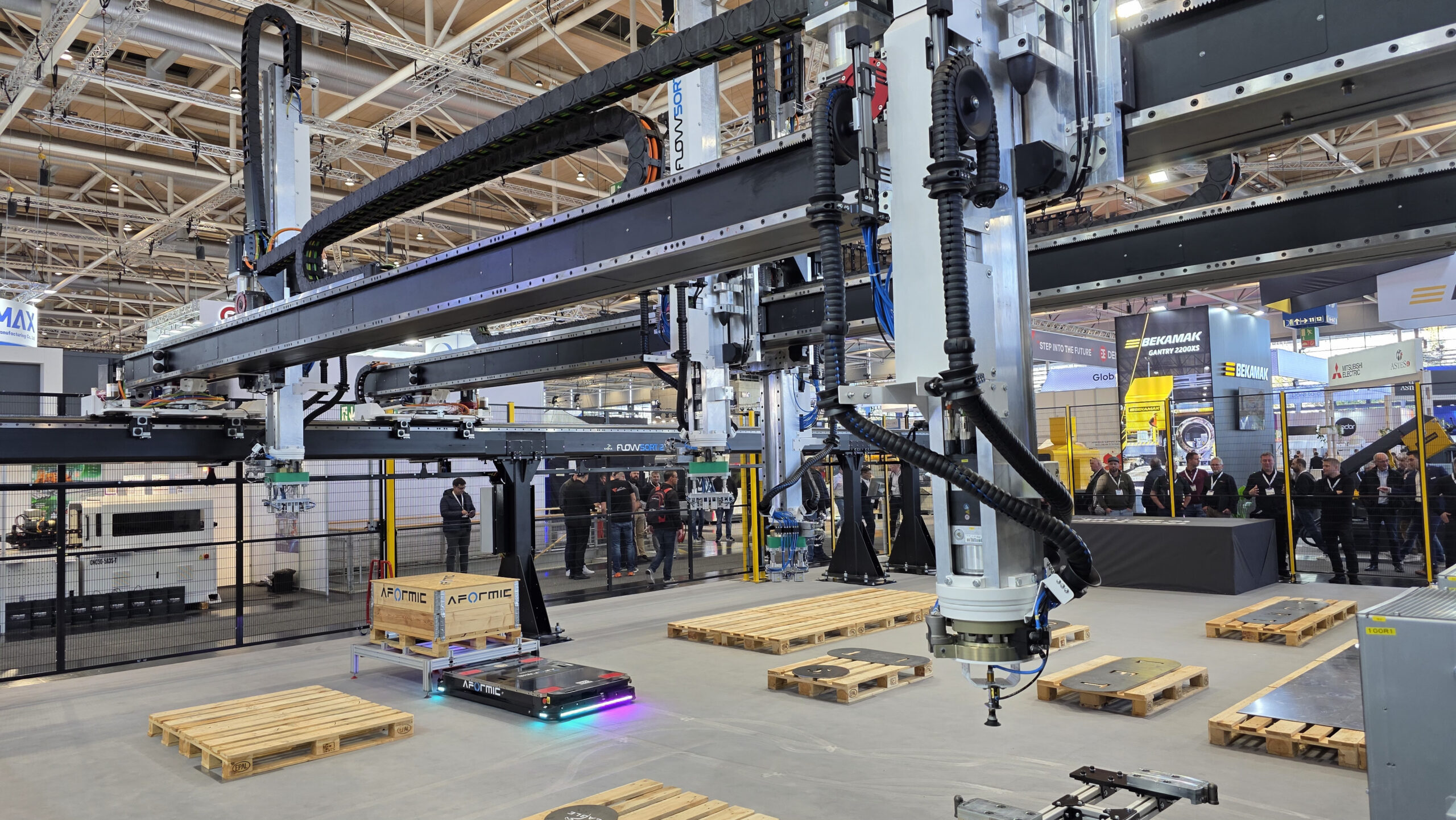
Eagle Lasers introduced FlowSORT at EuroBLECH 2026 with this approach in mind.
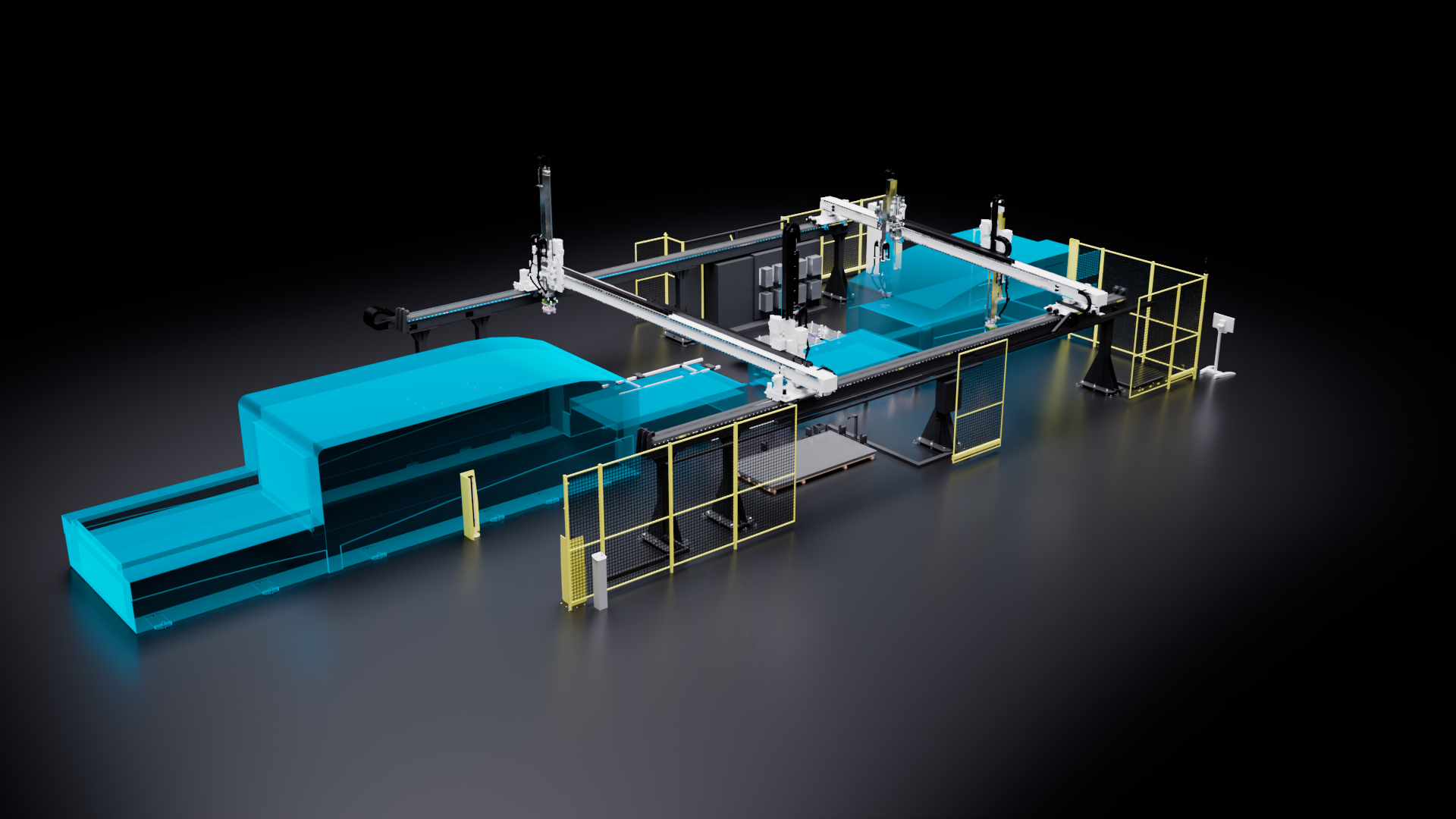
The system uses movable traverses, each carrying two independently controlled arms. The traverses can change their angle to accommodate the arrangement of parts on the cutting table. This allows one arm to collect a component while the other places a previously collected part, rather than requiring every movement to take place in sequence.
Magnetic and vacuum tools address different handling requirements, while the modular configuration allows the system to be arranged around multiple laser cutting machines. FlowSORT can also load raw sheets and remove the remaining skeleton after cutting.
These capabilities matter because part sorting is only one stage of a larger production process. Raw material has to reach the cutting table, finished components need to be collected and transferred, and the remaining skeleton must be removed before the next sheet can be processed. The more effectively these tasks are coordinated, the less likely it is that one operation will hold up the others.
The number of handling arms alone, however, tells us little about actual productivity. Performance depends on the components being processed, the layout of the installation, the distance travelled by each arm and the coordination of the different movements. A system that works well with one production mix may deliver different results with another.
Automation also brings its own requirements. Equipment needs floor space, programming, maintenance and a suitable arrangement for storing or transferring finished parts. These factors belong in the investment calculation alongside the potential reduction in manual handling.
For a workshop producing relatively simple components with long cutting cycles, manual sorting may remain the most economical choice. A manufacturer running several fast lasers and processing a continuous stream of different orders faces a different set of constraints. In that environment, handling capacity may deserve closer attention than it received when cutting times were longer.
The starting point is a review of the actual production process: how long machines wait for tables to be cleared, how much operator time goes into sorting, and where delays occur between cutting and the next operation. Those figures provide a more useful basis for evaluating automation than the specifications of a handling system alone.
Laser cutting will continue to get faster. For manufacturers investing in that progress, the next gains may depend as much on what happens after the cut as on the cutting process itself.