
Robots have been handling physical movement and repetitive tasks for a long time already. That’s all well and good until your shop floor starts slowing down with material waiting to be loaded on the machine, cut parts sitting unsorted, and downstream operations sitting idle.
That’s when AI can enter the picture and, in due time, be a real game-changer. What can it add to the process? The ability to use production data to support decisions. As Sheet Metal Industries puts it, AI can turn “data into decision-making power,” using information to identify changes and improve responses. Sounds trivial, or something a seasoned operator can do by mere instinct, but it’s not.
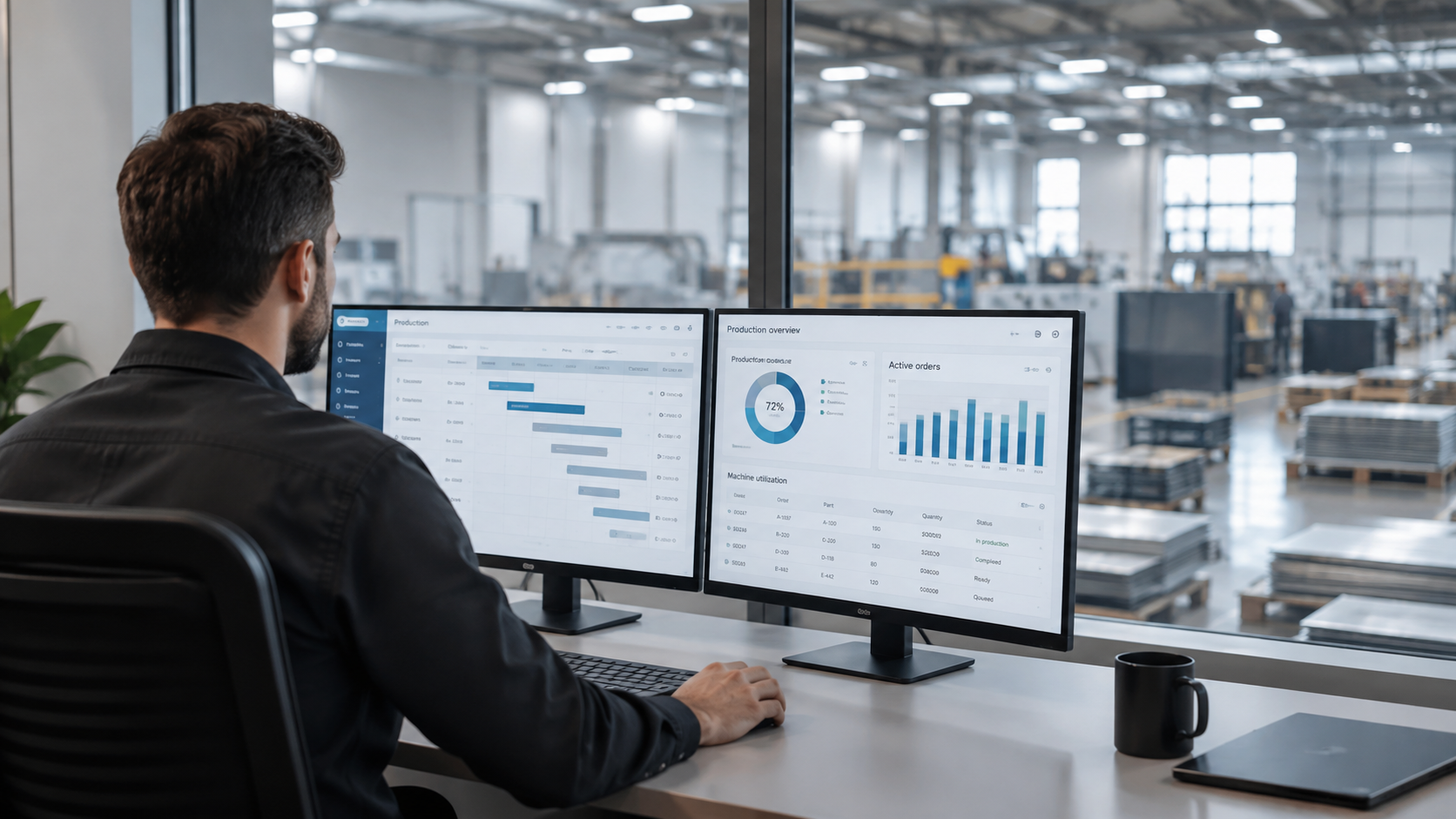
Automation is great when the process is predictable. As long as everything stays the same, you won’t have trouble. The scenario becomes trickier when that sequence changes. Orders arrive with different priorities, machines become unavailable, material is delayed, or a downstream operation takes longer than expected. A schedule created at the beginning of a shift may then no longer reflect what is happening on the floor hours later.
AI can identify these changes in real time and adjust your schedule accordingly. So can your most experienced workers. What they probably can’t do is predict when and where problems will occur. Research into AI applications in sheet metal forming describes how data can be used to identify patterns before process deviations become visible, moving manufacturing toward more proactive control.
Predictive maintenance follows the same principle. Sensor data such as vibration, temperature, or usage patterns can reveal changes before they result in an unexpected stoppage, allowing maintenance to be planned rather than triggered by failure.
We’re talking about a shift from reactive to effortless predictive production. Something that, until now, would have sounded more like sci-fi or wishful thinking than reality.

When it comes to examples, our sector is particularly ripe because it involves a sequence of closely connected activities: storage, nesting, cutting, unloading, sorting and further processing.
And laser cutting itself makes relationships even clearer. As cutting speeds increase, the time required to load the next sheet and remove the previous one becomes very important.
Where does AI fit in actual cutting? Nesting software can use algorithms to improve material utilization. Monitoring systems can identify unusual conditions or developing bottlenecks. Quality control is another example. AI-supported vision can analyze images and process data during production instead of waiting until a completed batch is inspected. In forming applications, machine-learning systems are being studied for predicting defects such as cracking, wrinkling, springback, and excessive thinning. The result is a system in which individual machines are less isolated from the operations around them.
As The Fabricator points out, a manufacturer can have highly productive equipment and still lose capacity elsewhere in the process chain. Here, AI can help by doing what it does best: process enormous amounts of information in seconds, something a human mind is simply not wired to do. It can examine sales and proposal data or use production knowledge to support estimating and engineering. This extends the idea of connected production beyond machines alone. The objective is to reduce delays between the commercial, planning, and production stages as well.
Of course, the AI’s contribution can be only as good as the data you feed to it. Fragmented or poorly organized data limits the value that AI can produce, regardless of its sophistication (and cost).
Software, machines, and handling equipment therefore need to exchange information correctly, and operators and technicians also need to understand the systems well enough to question their output when necessary.
The same principle applies to engineering. AI may help identify missed details or accelerate routine work, but experienced people still need to validate the result.
The overall direction is not simply toward more robots or more AI. It is toward a better exchange of information between man and machine. This is also how NIST frames the development of AI in smart manufacturing: progress depends not only algorithms, but on interoperability and integration.
For sheet metal manufacturers, that means the value of AI will increasingly be measured by something practical: whether it helps material, information and orders move through production with fewer interruptions.