Assist gas is one of the most important process decisions in fiber laser cutting. It does much more than blow molten metal away from the cut. It influences edge quality, cutting stability, speed, oxidation, post-processing, and ultimately the cost of producing each finished part.
The two most common assist gases are nitrogen and oxygen. They perform similar basic functions, but they behave very differently once the laser begins cutting the material. Nitrogen is inert, so it does not react chemically with the metal. Oxygen is reactive, meaning it actively participates in the cutting process by creating oxidation and additional heat.
Today, the choice is no longer limited to one or the other. Modern fiber laser systems can also use controlled gas mixtures, combining nitrogen and oxygen to balance edge quality, productivity, and process stability. The best option depends on the material, thickness, edge requirements, laser power, and what happens to the part after cutting.
During laser cutting, the beam melts or vaporizes the material along the cutting path. Assist gas helps remove that molten material from the kerf, stabilizes the cutting process, and supports the final edge quality.
It also helps protect the cutting area from contamination and reduces the risk of process instability caused by spatter, poor material removal, or uncontrolled oxidation.
This means that gas choice is not a secondary detail. It directly affects whether the part comes off the machine ready for the next production step, or whether it requires additional cleaning, grinding, preparation, or rework.
For that reason, assist gas should always be evaluated as part of the complete production process, not only as a gas-consumption cost.
Nitrogen cutting is often used when edge quality is the priority. Because nitrogen does not react with the material, it helps prevent oxidation and produces a clean, bright edge. This is why it is commonly associated with stainless steel, aluminum, visible components, and parts that will later be welded, painted, or coated.
In practical terms, nitrogen cutting helps reduce the need for secondary cleaning. The part can often move more directly into the next stage of production because the edge is not oxidized in the same way it would be after oxygen cutting.
This makes nitrogen particularly valuable in industries where appearance, corrosion resistance, weld quality, or repeatability matter. It is also a strong option when manufacturers want to simplify production flow by reducing manual finishing.
The trade-off is cost and process demand. Nitrogen cutting can require higher gas flow and careful parameter control, especially as material thickness increases. On thicker carbon steel, it may also be more difficult to maintain a completely burr-free edge without sufficient laser power and process stability.
So nitrogen is usually the right choice when the goal is a clean, oxidation-free edge and when downstream savings justify the higher gas-cost tendency. For more detail on how different metals behave under the laser beam, see What Materials Can Fiber Lasers Cut?
Oxygen cutting works differently. Instead of only removing molten material, oxygen reacts with the metal during cutting. This reaction creates additional heat, which can support the cutting process, especially in mild steel and carbon steel applications.
That additional energy can make oxygen useful in cases where the process benefits from a reactive assist gas. It is also often associated with lower gas consumption than nitrogen cutting.
However, the advantage comes with a clear compromise. Oxygen creates an oxidized edge. Depending on the final use of the part, that edge may require additional cleaning or preparation before welding, coating, or painting. In some applications this is acceptable. In others, it adds extra labor and cost.
This is why oxygen should not be judged only by gas price. A process that looks cheaper during cutting may become less attractive if it creates more work after cutting.
Oxygen remains a valid choice for mild steel applications where oxidation is acceptable, where post-processing is already part of the production route, or where the part does not require a bright, clean edge. It is less suitable when the priority is visual quality, corrosion-sensitive performance, or immediate readiness for downstream operations.
Controlled gas mix cutting creates a third option between pure nitrogen and pure oxygen. Instead of choosing only between a clean inert process and a reactive oxygen process, the system introduces a measured amount of oxygen into a nitrogen-based cutting flow.
The purpose is balance. Nitrogen helps maintain better edge quality, while oxygen contributes additional heat to support material removal. In the right application, this can improve cutting stability, reduce burr formation, and lower the amount of finishing required compared with oxygen cutting.
This approach can be especially useful in medium and thicker carbon steel applications, where nitrogen alone may create burr and oxygen alone may create too much oxidation. In these cases, a controlled gas mixture can help manufacturers find a more practical compromise between productivity and edge quality.
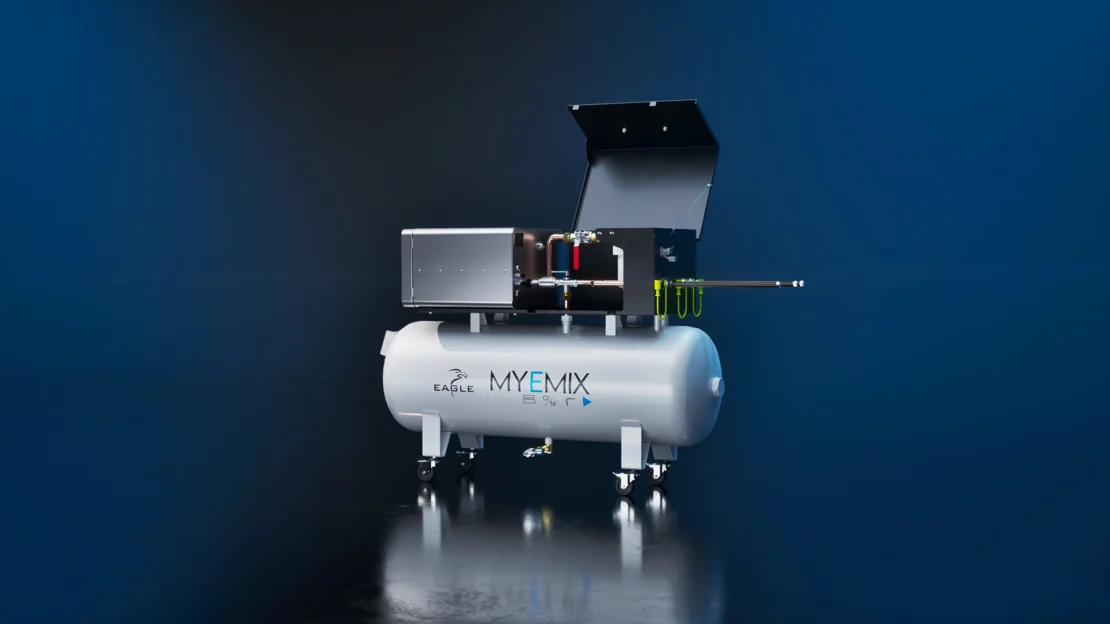
One example is Eagle MyEMIX, which allows nitrogen and oxygen to be combined in controlled proportions during cutting. The goal is not simply to replace one gas with another, but to create a more flexible process when neither pure nitrogen nor pure oxygen gives the best production result.
This is important because the real objective is not always maximum cutting speed or minimum gas cost. In many production environments, the better target is the lowest total cost per finished part.
Traditionally, oxygen was often associated with thicker mild steel, while nitrogen was used for cleaner, higher-quality cuts in thinner materials. That distinction is becoming less rigid.
Modern high-power fiber lasers can make nitrogen cutting more effective across a wider range of thicknesses. With sufficient power, machine dynamics, and process control, manufacturers can use nitrogen in applications where oxygen may previously have been the default choice.
The benefit is not only technical. Cleaner cutting can reduce the need for grinding, cleaning, or edge preparation. It can also improve consistency between batches and make the production process easier to control.
This is why gas choice increasingly depends on the full production route. The right question is not only “Which gas cuts this material?” but “Which gas produces the required finished part with the least total process cost?”
For more context, see Laser Cutting Operating Costs: Gas, Energy and Maintenance Explained.
| Factor | Nitrogen | Oxygen | Gas mix |
| Process type | Inert | Reactive | Controlled reactive |
| Main advantage | Clean, oxidation-free edge | Additional heat supports cutting | Balance between quality and efficiency |
| Edge quality | Very high | Oxidized, often lower | Medium to high |
| Post-processing | Usually minimal | Often required | Often reduced |
| Common fit | Stainless steel, aluminum, visible parts, high-quality components | Mild steel where oxidation is acceptable | Carbon steel where balance matters |
| Cost logic | Higher gas-cost tendency, often less finishing | Lower gas-cost tendency, possible finishing cost | Evaluated by total cost per part |
| Main limitation | More demanding on thicker materials | Oxidation and edge preparation | Requires precise process control |
Nitrogen is usually the best choice when the part needs a clean, bright, oxidation-free edge. It is particularly relevant for stainless steel, aluminum, visible components, and parts that move directly into welding, painting, or coating.
Oxygen makes sense when cutting mild steel applications where oxidation is acceptable and the process benefits from additional heat. It can be a practical option when edge appearance is less critical or when post-processing is already expected.
Gas mix cutting is worth considering when production needs a balance between the two. It can help when nitrogen creates burr, oxygen creates excessive oxidation, or the process needs better stability without sacrificing efficiency.
There is no universal best gas. The right choice depends on material type, thickness, edge requirement, laser power, gas availability, downstream operations, and the acceptable level of finishing work.
Gas quality still matters. Poor or inconsistent gas quality can affect process stability, edge quality, and repeatability.
However, exact requirements should not be generalized too broadly. They depend on the material, application, machine configuration, and cutting parameters. In production, gas quality should always follow the machine supplier’s recommendations and the required cutting result.
Nitrogen, oxygen, and gas mix cutting are not interchangeable. Each one changes how the cut is formed, what the edge looks like, how much finishing may be needed, and how the final cost per part is calculated.
Nitrogen supports clean, oxidation-free cutting. Oxygen adds reactive heat but creates an oxidized edge. Gas mix cutting offers a controlled middle ground when the process needs both quality and efficiency.
For modern sheet metal manufacturers, the best assist gas is not simply the cheapest one. It is the one that produces the required part quality with the lowest total process cost.